 +91-90411-60426 | ✉ india@thembbsabroad.com | info@thembbsabroad.com

ABOUT UNIVERSITY
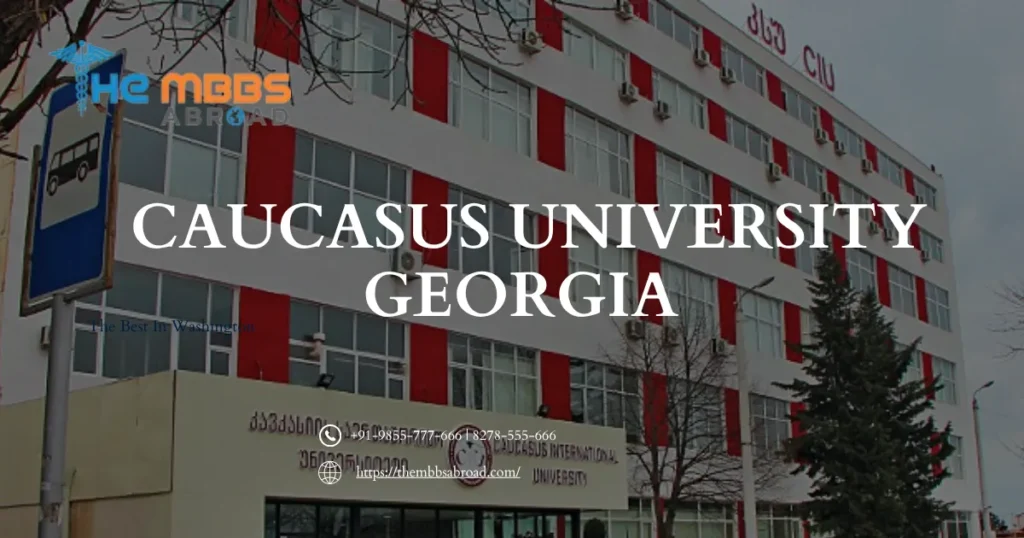
Caucasus University
Caucasus University (CU) in Tbilisi, Georgia, has emerged as one of the top destinations for Indian students pursuing an MBBS degree abroad. With affordable tuition fees of USD 6,000 per year, full NMC and WHO recognition, and English-medium instruction, it delivers world-class medical education at a fraction of the cost of private colleges in India.
This comprehensive guide covers everything you need to know about Caucasus University – from its history and global rankings to its fee structure, eligibility criteria, admission process, and career prospects after graduation.
Caucasus University History & Background
Caucasus University was formally established in 2004 in Tbilisi, the capital of Georgia. Its roots trace back to 1998, when the Caucasus School of Business (CSB) was founded through a collaboration between the US Government and Georgia State University – introducing the first Western-style business education in the country.
Today, CU has grown into one of the largest private universities in Georgia and the broader Caucasus region, housing ten specialised schools: Business, Law, Media, Technology, Architecture and Design, Governance, Humanities and Social Sciences, Tourism, Medicine, Economics, and Education. The Caucasus Medicine School – listed on the World Directory of Medical Schools (WDOMS) – is the dedicated faculty for the MBBS-equivalent Medical Doctor (MD) programme.
Caucasus University Highlights 2026
Parameter | Details |
Full Name | Caucasus University (CU) |
Founded | 2004 (roots from 1998) |
Location | Tbilisi, Georgia |
University Type | Private Higher Education Institution |
Medium of Instruction | English (for international students) |
Programme Offered | MD Programme (equivalent to MBBS) |
Course Duration | 6 Years (5 academic + 1 internship) |
Annual Tuition Fee | USD 6,000 (~INR 5,40,000) |
QS World Ranking 2026 | #651–700 |
Country Ranking (Georgia) | #3 |
NMC Recognised | Yes |
WHO Recognised | Yes |
ECFMG Listed | Yes |
Total Credits | 360 ECTS (max 75/year) |
International Partnerships | 265+ institutions in 68 countries |
Indian Student Community | 500+ Indian students on campus |
Why Choose Caucasus University for MBBS? Top 8 Reasons
Thousands of Indian students apply to Caucasus University every year. Here are the most compelling reasons why it consistently ranks among the best universities to study MBBS in Georgia:
1. Full NMC & WHO Recognition
CU is approved by the National Medical Commission (NMC) of India, WHO, WFME, ECFMG, and is listed on WDOMS. Indian graduates are eligible to appear for the NExT/FMGE licensing examination to practice medicine in India after completing their degree.
2. Affordable MBBS Fees
The annual tuition is USD 6,000, significantly lower than private medical colleges in India that charge INR 50–80 lakh total. The total six-year cost – including tuition, hostel, food, and insurance – is approximately USD 48,600 (INR 43,74,000).
3. English-Medium Instruction
The entire MD programme is taught in English. No Georgian language requirement exists for the MBBS curriculum, eliminating the language barrier for Indian students.
4. No IELTS or TOEFL Required
Caucasus University does not mandate IELTS or TOEFL for admission. Basic proficiency in English is sufficient, making the application process simpler for Indian applicants.
5. Global Degree Recognition
CU graduates can sit for licensing exams in multiple countries: NExT/FMGE (India), USMLE (USA), PLAB (UK), and DHA/MOH/HAAD (Gulf countries), opening global career opportunities.
6. Modern Campus & Clinical Exposure
The campus features smart classrooms, advanced laboratories, 3D virtual anatomy software, simulation centres, and digital libraries. Clinical rotations start from the 3rd year in affiliated hospitals, providing early hands-on patient experience.
7. High Graduate Employment Rate
Over 90% of CU graduates and 80% of current students are employed after completing their degree – one of the highest placement rates among Georgian universities.
8. Affordable Cost of Living in Tbilisi
Apart from low tuition, the cost of living in Tbilisi is among the most affordable in Europe. Monthly expenses including accommodation and food range between USD 350–500, making Georgia an economical destination for international students.
Caucasus University Recognition & Accreditation
CU is a fully accredited institution recognised by several national and international regulatory bodies. Its institutional accreditation is awarded by the National Centre for Educational Quality Enhancement (NCEQE) of Georgia, and it is approved by the Ministry of Education and Science of Georgia.
Additional recognitions include:
- National Medical Commission (NMC), India
- World Health Organisation (WHO)
- World Federation for Medical Education (WFME)
- Educational Commission for Foreign Medical Graduates (ECFMG)
- World Directory of Medical Schools (WDOMS) – listed as Caucasus Medicine School
- General Medical Council (GMC), UK
- Ministry of Education and Science, Georgia
NMC Compliance 2026: Is Caucasus University MBBS Valid in India?
Yes, Caucasus University fully complies with all NMC (National Medical Commission) guidelines for foreign medical institutions. Here is a checklist of NMC compliance:
NMC Criteria | CU Status | Details |
Minimum Course Duration | Compliant | 6 years (5+1) – exceeds the 4.5-year NMC minimum |
Medium of Instruction | Compliant | 100% English-taught MD programme |
Mandatory Subjects | Compliant | All 19+ NMC-mandated subjects are covered |
Degree Validity | Compliant | MD recognised by NCEQE & Ministry of Education, Georgia |
Mandatory Internship | Compliant | 1-year clinical internship in affiliated hospitals |
Screening Examination | Compliant | Graduates eligible for NExT/FMGE to practise in India |
Note: Indian students must clear the NExT (National Exit Test) – which has replaced FMGE/NEET PG – to obtain a medical licence in India after returning from abroad.
Caucasus University MBBS Fee Structure 2026
One of the most searched topics by Indian students is the Caucasus University MBBS fees. Here is a transparent and complete breakdown:
Expense Head | Annual Cost (USD) | Annual Cost (INR ~@90) |
Tuition Fee | $6,000 | INR 5,40,000 |
Hostel + Food | $3,000 | INR 2,70,000 |
Application + TRC + Ministry | $1,000 (1st year only) | INR 90,000 |
Medical Insurance | $100 | INR 9,000 |
Total (1st Year) | $10,100 | INR 9,09,000 |
Total (2nd–6th Year each) | $9,100 | INR 8,19,000 |
Grand Total (6 Years) | ~$48,600 | ~INR 43,74,000 |
Important notes:
- The figures above are estimates; the actual amounts are subject to change based on university policy and exchange rates.
- INR figures are calculated at USD 1 = INR 90.
- There are no hidden charges or donations required.
- Scholarships are available for meritorious international students, which can offset a portion of tuition costs.
Caucasus University World Ranking 2026
Caucasus University has steadily improved its global academic standing. Below are the rankings from multiple frameworks:
Ranking Framework | Rank |
QS World University Rankings 2026 | 651–700 |
Times Higher Education (THE) 2025 | 1001–1500 |
THE Impact Rankings 2025 | 1501+ |
Georgia Country Ranking | 3 |
UniRank 2026 (World) | 6,945 |
Ranked #3 in Georgia, CU is consistently among the top three universities in the country and is highly regarded for its medical programmes across Eastern Europe and the Caucasus region.
Caucasus University MBBS (MD) Course Details & Syllabus
The Medical Doctor (MD) programme at Caucasus University is a 6-year English-medium course structured as 5 years of academic study followed by 1 year of mandatory clinical internship. It follows the European Credit Transfer and Accumulation System (ECTS) with a total of 360 credits (maximum 75 per academic year).
Year-wise Curriculum Structure
Phase | Years | Key Subjects |
Pre-Clinical | Year 1–2 | Anatomy, Histology, Embryology, Cell & Molecular Biology, Medical Biology, Medical Chemistry, Physiology, Biochemistry |
Para-Clinical | Year 3–4 | Pathology, Microbiology, Immunology, Pharmacology, Laboratory Diagnostics, Preventive Medicine, Medical Genetics |
Clinical | Year 5–6 | Internal Medicine, Surgery, Pediatrics, Obstetrics & Gynecology, Neurology, Psychiatry, ENT, Ophthalmology, Dermatology |
Internship | Year 6 (Mandatory) | Rotations in affiliated hospitals covering all major medical specialties |
Curriculum highlights include 3D virtual anatomy software, problem-based learning (PBL) sessions, simulation labs, and access to clinical education at partner hospitals from the third year onwards.
Eligibility Criteria for MBBS at Caucasus University 2026
Before applying, Indian students must ensure they meet the following eligibility requirements:
Criterion | Requirement |
Minimum Age | 17 years by December 31 of the admission year |
Maximum Age | 25 years (as per NMC guidelines) |
Academic Qualification | 10+2 with Physics, Chemistry & Biology (PCB) |
Minimum Marks – General Category | 50% aggregate in PCB |
Minimum Marks – Reserved Category (SC/ST/OBC) | 40% aggregate in PCB |
NEET Qualification | Mandatory for Indian students (as per NMC norms) |
English Proficiency | Basic English proficiency sufficient; IELTS/TOEFL not required |
Passport Validity | Valid passport with minimum 1-year validity remaining |
Step-by-Step Admission Process at Caucasus University 2026
The Caucasus University admission process is straightforward and can be completed largely online. Here is a complete step-by-step guide:
Step 1 – Online Registration: Visit the official Caucasus University website, choose the MD programme, fill in the online application form, and email the required scanned documents to IR@CU.EDU.GE.
Step 2 – Document Submission: Submit all required documents (see Documents Required section below). Documents must be submitted within one week of registration.
Step 3 – Video Interview: An admissions officer will conduct a short video interview to assess the applicant’s motivation and English communication skills.
Step 4 – Pay Application Fee: Successful interviewees pay a non-refundable application fee via bank transfer to CU’s designated bank account.
Step 5 – Pay Tuition Fee & Receive Enrollment Letter: After interview clearance, students pay the first-year tuition fee to receive the official enrollment letter from the university.
Step 6 – Receive Invitation Letter & Apply for Visa: CU issues an Invitation Letter, which students use to apply for a Georgian student visa at the relevant Georgian Embassy or Consulate in India.
Step 7 – Travel & Arrival in Tbilisi: Once the visa is approved, students travel to Tbilisi. On arrival, students attend orientation, complete on-campus registration, and begin their classes.
Documents Required for Caucasus University MBBS Admission
The following documents must be submitted (both soft copies and hard copies):
- Class 10th mark sheet and passing certificate
- Class 12th mark sheet and passing certificate
- NEET Scorecard (valid for 3 years from the date of result)
- Valid Passport (original + scanned copy)
- Passport-size photographs (3×4 cm, white background)
- HIV test report (negative)
- COVID-19 test report (negative)
- Birth certificate
- Provisional Admission/Offer Letter (if already received)
- Bank statement or sponsor’s financial declaration
MBBS Intake Dates & Application Timeline 2026
Caucasus University offers two MBBS intakes per year:
Intake | Type | Application Period | Admission Letters | Visa Processing | Classes Begin |
September Intake | Primary (Main) | May – July | June – August | July – September | September – October |
February Intake | Secondary (Optional) | October – December | November – January | December – February | February – March |
The September intake is the principal intake and is recommended for most Indian students. The February intake is suitable for students who missed the main deadline.
Student Life & Campus Facilities at Caucasus University
Life at Caucasus University is vibrant, diverse, and well-supported for international students, particularly those from India.
Accommodation
CU assists students in securing private hostels near the campus in Tbilisi. Rooms are available in double or triple sharing with individual beds, study tables, wardrobes, and climate control (AC and heating). CCTV surveillance, 24/7 security guards, and separate wings for male and female students ensure safety.
Food
Indian students have access to Indian mess facilities on campus, with both vegetarian and non-vegetarian meals prepared daily. The university also has a canteen with local Georgian and international cuisine.
Recreational Activities
The CU campus includes a sports field, swimming pool, library, and recreational zones. With over 500 Indian students currently enrolled, there is a thriving Indian student community that celebrates cultural festivals like Diwali and Holi on campus.
Internet & Connectivity
High-speed Wi-Fi is available across the campus and in hostel facilities. The university uses digital platforms for e-learning, assignments, and academic communication.
About Tbilisi: Why It's an Ideal City for Indian Medical Students
Tbilisi, the capital of Georgia, is a historically rich, safe, and student-friendly city built along the banks of the Kura River. Home to approximately 1.2 million people, it is Georgia’s economic and cultural hub.
City Highlights | Details |
Region | Eastern Georgia |
Population | Approx. 1.2 million |
Climate | Subtropical – warm summers (25–36°C), mild winters (0–8°C) |
Time Zone | Georgia Standard Time (UTC+4) |
Connectivity | Road, Railway, Metro & International Airport (TBS) |
Major Attractions | Old Tbilisi, Narikala Fortress, Sulphur Baths, Peace Bridge |
Monthly Living Cost (Student) | ~USD 350–500 (approx. INR 31,500–45,000) |
Safety Rating | Among the safest student cities in Europe |
Georgia is a visa-free country for many nationalities and is known for its warm hospitality, affordable markets, and low crime rate – ideal for Indian students studying abroad for the first time.
Career Opportunities After MBBS from Caucasus University
An MBBS/MD degree from Caucasus University opens doors to medical practice across the world. Here is a detailed breakdown of career options:
Practice in India
- Clear the NExT (National Exit Test) – the new licensing exam replacing FMGE/NEET PG
- Complete a one-year rotatory internship (mandatory)
- Register with the National Medical Register (NMR)
- Join government or private hospitals, start your own clinic, or work with NGOs in rural health
Practice in the USA
- Clear USMLE Steps 1, 2, and 3
- Apply for residency via the NRMP Match
- CU’s ECFMG listing makes graduates eligible
Practice in the UK
- Clear the PLAB (Professional and Linguistic Assessments Board) exam
- Register with the General Medical Council (GMC)
- Join the NHS as a foundation doctor
Practice in the Gulf (UAE, Saudi Arabia, Qatar)
- Clear country-specific exams: DHA (Dubai), MOH (Ministry of Health), HAAD (Abu Dhabi), SCFHS (Saudi Arabia)
- High salary packages – USD 4,000–10,000/month for qualified doctors
Practice in Georgia
- Graduate and register with the Georgian Medical Council
- Work in Georgian hospitals, research institutions, or academic settings
Postgraduate Studies (MD/MS/PhD)
- Pursue PG specialization in India (after clearing NExT), USA (after USMLE), UK (after PLAB), or Germany
- Research opportunities available at CU’s affiliated institutions
Caucasus University vs Other Top Medical Universities in Georgia
Here is how Caucasus University compares with other leading Georgian medical universities for Indian students:
University | Founded | Annual Fees (USD) | Georgia Rank | NMC Recognised |
Caucasus University | 2004 | $6,000 | #3 | Yes |
Georgian National University SEU | 2001 | $5,500 | Top 5 | Yes |
University of Georgia | 2004 | $6,000 | Top 5 | Yes |
Geomedi Medical University | 1998 | $5,500 | Top 10 | Yes |
David Tvildiani Medical University | 1989 | $7,500 | Top 5 | Yes |
East European University | 2012 | $5,500 | Top 10 | Yes |
Caucasus International University | 1995 | $6,000 | #15 (UniRank) | Yes |
Caucasus University Scholarships for Indian Students
Caucasus University offers several scholarship programmes for international students to help offset tuition costs:
- International Student Grant – available to all non-Georgian nationals, including Indian students
- Academic Excellence Award – for students with top academic performance in university semester exams
- Programme-Specific Scholarships – available for selected undergraduate and postgraduate programmes
Scholarships can cover a portion or all of the tuition fees. Students must apply separately for scholarships on the official CU website after submitting their academic documents and NEET scorecard.
Frequently Asked Questions (FAQs)
Q1: Is Caucasus University MBBS recognised in India by NMC?
Yes. CU is fully NMC-recognised, WDOMS-listed, and WHO-approved. Indian graduates are eligible to sit for the NExT examination to obtain a medical licence in India.
Q2: What is the total MBBS fee at Caucasus University in INR ?
The total 6-year cost including tuition, hostel, food, and insurance is approximately USD 48,600, which is equivalent to about INR 43,74,000 at an exchange rate of USD 1 = INR 90.
Q3: Is NEET compulsory for Caucasus University admissions?
Yes. NEET qualification is mandatory for Indian students seeking MBBS admission abroad as per NMC norms. However, a high NEET score is not required – qualification is sufficient.
Q4: Is IELTS or TOEFL required for Caucasus University?
No, Caucasus University does not require IELTS or TOEFL scores. Basic English communication skills are sufficient for admission.
Q5: What is the world ranking of Caucasus University in 2026?
Caucasus University is ranked #651–700 in the QS World University Rankings 2026 and #3 in Georgia.
Q6: Can Indian students work part-time in Georgia?
Yes, Georgia permits international students to work part-time while studying, making it financially easier to manage living expenses during the course.
Q7: What are the two intake sessions at Caucasus University?
The two annual intakes are: September (primary/main intake) and February (secondary intake). September is recommended for Indian students.
Q8: How many Indian students study at Caucasus University?
Over 500 Indian students are currently enrolled at CU’s Caucasus Medicine School, forming a strong and active Indian student community on campus.
Q9: What happens after the 6-year MBBS at Caucasus University?
After completing the 6-year MD programme (including 1-year internship), Indian students can: (1) appear for NExT to practice in India, (2) clear USMLE for the USA, (3) clear PLAB for the UK, or (4) pursue PG studies in Georgia or any country of their choice.
Q10: Are hostel facilities available for Indian students at Caucasus University?
Yes, CU arranges private hostel accommodation near the campus in Tbilisi with separate wings for boys and girls, Indian mess, 24/7 security, Wi-Fi, and essential amenities at approximately USD 250–300 per month.