 +91-90411-60426 | ✉ india@thembbsabroad.com | info@thembbsabroad.com
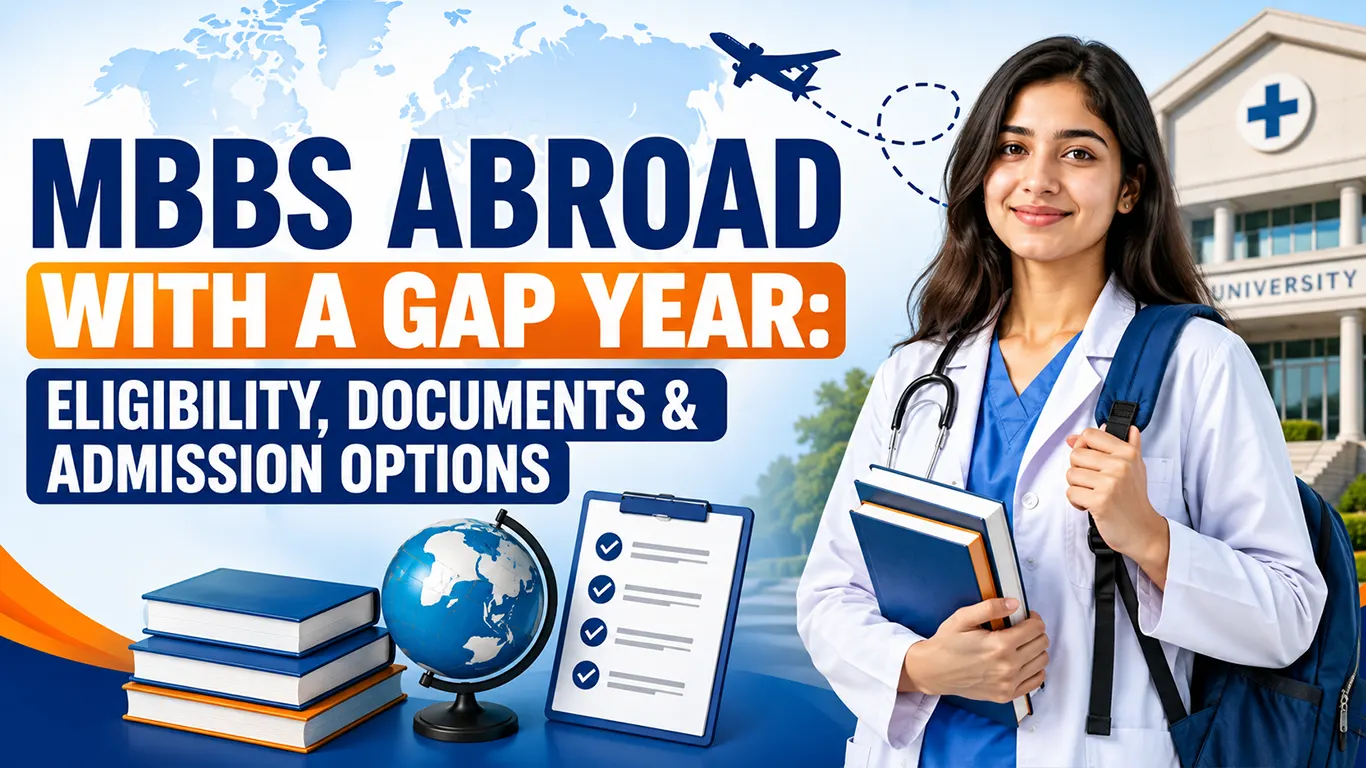
Table of Contents
- Does a Gap Year Affect MBBS Abroad Admission?
- NMC Eligibility Criteria for MBBS Abroad in 2026
- How Does NEET Validity Work for Gap Year Students?
- Documents Required for MBBS Abroad After a Gap Year
- Admission Options for Gap Year Students
- Common Mistakes Gap Year Students Should Avoid
- Why a Gap Year Can Actually Work in Your Favor
- Final Thoughts
- Frequently Asked Questions
Taking a gap year after Class 12 is one of the most common situations Indian medical aspirants face. Whether the year was spent preparing for NEET, waiting for a better rank, dealing with a health issue, or simply figuring out the next step, one worry stays constant: will a gap year affect MBBS abroad admission?
The good news is that a gap year does not disqualify you from studying MBBS abroad. Unlike many government seats in India that are extremely rank sensitive, MBBS admission abroad is far more flexible when it comes to gap years, age, and NEET attempts. That said, there are specific eligibility rules, document requirements, and timelines set by the National Medical Commission (NMC) that every student with a gap year must understand before applying.
This guide covers everything in detail, from eligibility criteria and NEET validity to the exact documents you need and the admission options available to gap year students in 2026.
Does a Gap Year Affect MBBS Abroad Admission?
For most universities abroad, a gap year of one, two, or even three years does not create any admission barrier. Foreign medical universities in Russia, Georgia, Kazakhstan, Kyrgyzstan, Uzbekistan, and the Philippines admit students purely on the basis of NEET qualification, Class 12 marks, and age criteria, not on how many years have passed since school.
There is no rule from the NMC that blocks a candidate with a gap year from pursuing MBBS abroad. What actually matters is:
- You must have qualified NEET-UG at some point.
- Your NEET result must still be valid, or you must be willing to reappear.
- You must meet the minimum age requirement at the time of admission.
- Your Class 12 documents and eligibility certificate must be in order.
If these four boxes are ticked, a gap year of any reasonable length is not a problem for admission abroad.
NMC Eligibility Criteria for MBBS Abroad in 2026
The NMC (formerly the Medical Council of India) regulates every aspect of studying medicine outside India for Indian citizens and OCI cardholders. If you plan to practice medicine in India after your MBBS abroad, you must meet the following criteria regardless of whether you have a gap year or not.
1. Class 12 Qualification
You must have passed Class 12 with Physics, Chemistry, Biology, and English as core subjects. The minimum aggregate required in PCB is 50% for General and EWS category students, and 40% for SC, ST, and OBC category students. Universities abroad generally accept this same benchmark since it aligns with NMC’s Graduate Medical Education Regulations.
2. NEET-UG Qualification
Qualifying NEET-UG is mandatory for every Indian student pursuing MBBS abroad, with no exceptions. Your NEET result itself acts as your eligibility certificate, provided you also satisfy the other criteria under the regulations. This is one of the most important points for gap year students to note, since NEET is not just an entrance test for Indian colleges, it is a legal requirement for practicing medicine in India after a foreign degree.
3. Age Requirement
There is currently no upper age limit for MBBS abroad. A candidate must be at least 17 years old by 31st December of the admission year, but there is no maximum age cutoff, which makes MBBS abroad a genuinely workable option for students who have taken multiple gap years, career changers, or those who started later than usual. Some universities in countries like Georgia and Kazakhstan may have their own internal preference for the minimum age of 17 during the academic year, so it is worth confirming this with your chosen university directly.
4. Course Duration and Structure
As per NMC’s Foreign Medical Graduate Licentiate (FMGL) Regulations, 2021, the MBBS course abroad must be at least 54 months (4.5 years) in duration, followed by a mandatory 12-month internship completed in the same country and, wherever possible, the same institution where the course was pursued. No part of the clinical or practical training can be delivered online or in hybrid mode.
5. Medium of Instruction
Classes and examinations must be conducted in English. If a university teaches in the local language with only partial English support, the degree may face recognition issues later, so this should be verified before enrolling.
How Does NEET Validity Work for Gap Year Students?
This is the part that confuses most gap year students, so it deserves a closer look.
Your NEET-UG result is valid for three years from the date the result is declared, and it entitles you to pursue MBBS abroad within that window across multiple admission cycles. This means:
- If you qualified NEET two years ago and did not use that attempt for admission, you can still use it now.
- If your NEET qualification is more than three years old, it is no longer valid for a fresh admission, and you would need to reappear.
- There is no cap on the number of NEET attempts, so reappearing is always an option regardless of how many gap years you have taken.
Before applying, always check the exact declaration date of your NEET result and count three years forward from that date. Many students miss this detail and assume the “gap year” itself resets or extends validity, which is not how the rule works. If you are unsure whether your score still qualifies, it helps to go through the complete NEET PG eligibility criteria before you start shortlisting universities.
Documents Required for MBBS Abroad After a Gap Year
Gap year applicants generally need the same core documents as fresh Class 12 pass-outs, with a few additional papers to explain the gap. Keeping this list ready in advance avoids last-minute delays during visa processing and university enrollment.
Academic Documents
- Class 10 mark sheet and certificate
- Class 12 mark sheet and certificate, with PCB and English clearly reflected
- Valid NEET-UG scorecard within the three-year validity window
- Migration certificate (if applicable)
- Transfer certificate from your last attended school or institution
Identity and Eligibility Documents
- Valid passport with at least 18 to 24 months validity remaining
- Passport-size photographs as per university and visa specifications
- Birth certificate as proof of date of birth
- NMC Eligibility Certificate, which for post-2018 admissions is effectively your qualifying NEET result
Gap Year Specific Documents
- A gap year affidavit or self-declaration explaining the reason for the break, notarized where required
- Any supporting proof for the gap, such as coaching institute certificates, medical records for a health-related gap, or employment letters if you worked during that period
- A No Objection Certificate from your school or previous institution, if requested
Visa and Travel Documents
- Visa application form for the destination country
- Bank statements or financial documents showing sufficient funds
- Admission or offer letter from the university
- Medical fitness certificate and vaccination records
- Health and travel insurance for the duration of study
Since visa and embassy requirements differ by country, it always helps to confirm the exact checklist with your university or consultant before you start the apostille and attestation process, since even a small missing document can delay your admission cycle.
Admission Options for Gap Year Students
Gap year students genuinely have a wide set of options abroad, and in many cases, the flexibility works in their favor since universities run more than one intake per year.

Multiple annual intakes make MBBS abroad a practical route for students with gap years
Countries With Flexible Intakes
Several destinations run two or even three intakes annually, typically in September, February, and sometimes November, which means a gap year student is rarely forced to wait a full year for the next admission cycle. Russia, Georgia, Kazakhstan, Kyrgyzstan, and Uzbekistan are commonly chosen for this reason, along with relatively affordable tuition and NMC-compliant course structures.
Universities With No Age Bias
Since these universities evaluate applications on academic score and NEET qualification rather than age, a 19-year-old and a 23-year-old with the same NEET score are generally treated the same way in the admission process. This is very different from many domestic private colleges where counseling rounds are heavily rank and timeline dependent. Destinations such as MBBS in Georgia are a good example of this, since admission is based on NEET qualification and academic eligibility rather than how many years have passed since Class 12.
Direct Admission Through Verified Channels
Because a gap year application involves extra documentation, it is advisable to apply through the university’s official admission office or a verified education consultant rather than informal agents, so that your eligibility certificate, NEET validity, and gap year affidavit are all cross-checked before you travel.
Bridge or Preparatory Programs
If your gap has been particularly long or your PCB percentage is on the lower edge, some universities offer a short preparatory or foundation term before the main MBBS program begins. This is not mandatory everywhere, but it can be a useful option if you want to refresh core science concepts before starting a demanding medical curriculum.
Common Mistakes Gap Year Students Should Avoid
- Assuming NEET validity resets with every gap year and applying with an expired scorecard.
- Choosing a university purely on lower fees without confirming NMC compliance on course duration, internship structure, and medium of instruction.
- Skipping the gap year affidavit or NOC, which can later complicate visa interviews or the NMC eligibility certificate process.
- Believing agents who claim MBBS abroad is possible without NEET. This degree will not be recognized in India, regardless of how convincing the offer sounds.
- Delaying the passport renewal or apostille process until the last few weeks before intake, which is one of the most common causes of missed admission cycles.
Why a Gap Year Can Actually Work in Your Favor
While most students see a gap year as lost time, it can genuinely work in your favor if used well. A gap year gives you more time to research universities thoroughly, compare tuition and living costs across countries, understand the FMGE or NExT licensing requirements in detail, and prepare financially and mentally for studying in a new country. Many successful doctors practicing in India today completed their MBBS abroad after one or more gap years, and their timeline made no difference to their eligibility for practicing medicine once they cleared their licensing exam.
Final Thoughts
A gap year is not the obstacle it is often made out to be when it comes to MBBS abroad. As long as you hold a valid NEET qualification, meet the minimum age requirement, and keep your documentation in order, universities abroad are generally open to admitting students regardless of how long ago they finished Class 12. The real work lies in choosing an NMC-compliant university, keeping your NEET validity in check, and preparing your paperwork early so that a gap year does not turn into a second delay.

Keeping your NEET validity and documentation in order is the key to a smooth admission