 +91-90411-60426 | ✉ india@thembbsabroad.com | info@thembbsabroad.com
Table of Contents
- Why Document Preparation Matters for MBBS Abroad Admission
- 1. Academic Documents
- 2. Identity and Personal Documents
- 3. Medical and Health Documents
- 4. Financial Documents
- 5. University Application Documents
- 6. Document Attestation and Apostille
- Documents Required After Reaching Your MBBS Destination
- Common Mistakes Students Make with MBBS Abroad Documents
- Final Thoughts
- Frequently Asked Questions (FAQs)
Every year, thousands of Indian students choose to study MBBS abroad in countries like Georgia, Russia, and Bosnia and Herzegovina because of affordable tuition fees, globally recognized degrees, and simple admission procedures. But before you pack your bags and book your flight, there is one part of the process that decides whether your MBBS abroad admission goes smoothly or gets delayed: paperwork.
Missing a single certificate, an incorrect attestation, or an expired passport can push your admission or visa process back by weeks. That is why having a clear, updated checklist of documents required for MBBS abroad admission in 2026 is so important for students and parents alike.
In this blog, we will walk you through every document you need at each stage, from the initial university application to your visa stamping and final departure, so you can start your medical journey without any last-minute stress.
Why Document Preparation Matters for MBBS Abroad Admission
MBBS admission abroad in 2026 works differently from admission through Indian counselling. Universities in Georgia, Russia, and Bosnia require applicants to submit an admission file that is reviewed by the university, and later by the embassy for visa approval. Every document in this file must match NMC (National Medical Commission) and WHO guidelines, since only NMC and WHO approved universities allow Indian students to practice medicine in India after graduation.
Incomplete or incorrectly attested documents are one of the most common reasons students face visa delays or even rejection. Working with an experienced MBBS abroad consultancy can help you avoid such errors, since consultants are familiar with each country’s exact documentation format and attestation process.
Complete List of Documents Required for MBBS Abroad Admission in 2026
Below is a detailed, stage-wise breakdown of the documents you will need.
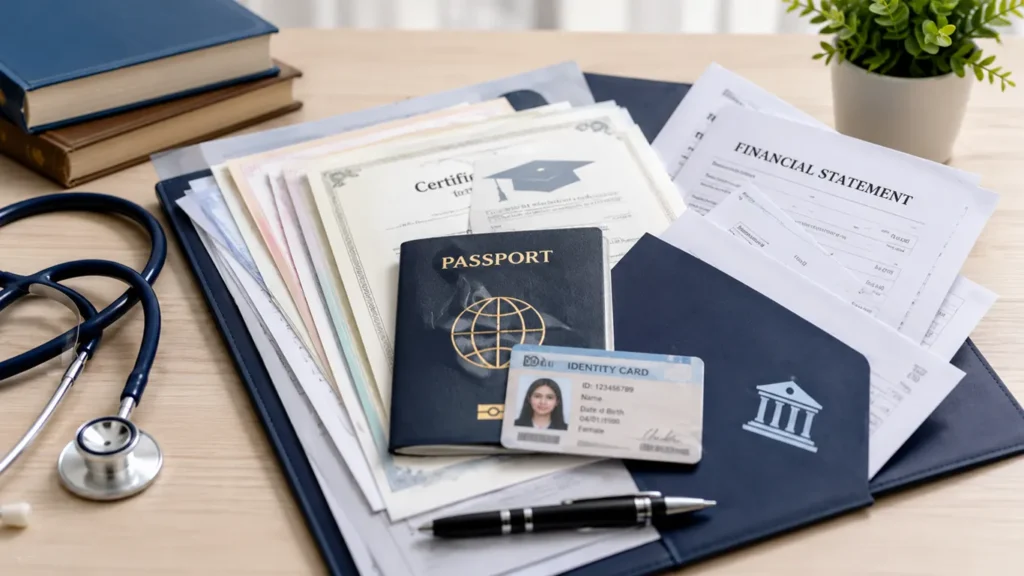
Academic records, identity proof, and financial documents together form your admission file
1. Academic Documents
Academic records form the foundation of your MBBS abroad application. Universities use these to confirm your eligibility for the medical program.
- Class 10th Mark Sheet and Certificate: Proof of your basic academic record and date of birth.
- Class 12th Mark Sheet and Certificate: Must show Physics, Chemistry, and Biology (PCB) as core subjects with a minimum aggregate score, generally 50 percent for general category and 40 percent for reserved categories, as per NMC norms.
- NEET UG Scorecard: A valid NEET UG qualifying score is mandatory for every Indian student seeking MBBS admission abroad in 2026, since NMC regulations require it for future practice in India.
2. Identity and Personal Documents
These documents establish your identity for both the university and the immigration authorities of your chosen country.
- Valid Passport: Should have a minimum validity of 18 to 24 months from the date of your intended travel. If you do not have a passport yet, apply for it well in advance, as passport processing can take several weeks.
- Passport Size Photographs: Usually 8 to 10 copies in the specific size and background color required by the university and embassy.
- Birth Certificate: Needed for identity verification and, in some cases, visa processing.
3. Medical and Health Documents
Foreign universities and immigration departments require proof that you are medically fit to travel and study abroad.
- Medical Fitness Certificate: Issued by a registered medical practitioner, confirming you are fit for higher education abroad.
4. Financial Documents
Financial documents prove that you or your family can support the cost of tuition, accommodation, and living expenses throughout the MBBS course.
- Bank Statement: Usually the last 6 months of statements from a parent or sponsor’s account.
- Income Proof of Parent/Guardian: Salary slips, ITR (Income Tax Return) copies, or a CA-certified income certificate.
- Fee Payment Receipt: Proof of tuition fee deposit once you confirm admission, often required for visa stamping.
- Sponsorship Letter (if applicable): If a relative or guardian other than parents is funding your education.
5. University Application Documents
Once you shortlist a university, whether it is in Georgia, Russia, or Bosnia and Herzegovina, you will need to submit an admission offer letter, issued by the university after your application is reviewed and accepted. This becomes the key document for your visa application.
- Admission Offer Letter: Issued by the university after your application is reviewed and accepted. This becomes the key document for your visa application.
If you are exploring options in Georgia, our detailed page on MBBS in Georgia lists the top NMC and WHO approved universities along with their specific admission requirements.
6. Document Attestation and Apostille
This step is often overlooked but is critical for MBBS abroad admission in 2026. Many countries require your academic and personal documents to be attested or apostilled by the Ministry of External Affairs (MEA) and, in some cases, further legalized by the destination country’s embassy in India. This process authenticates your documents so they are accepted internationally.
Common documents that need apostille or attestation include:
- Class 10th and 12th certificates
- Passport copy
- Birth certificate
- Medical certificates
Since attestation procedures can take time and involve multiple government departments, most students prefer to have an experienced consultancy manage this on their behalf. This is exactly the kind of pre-landing support covered in our admissions process guide, which explains how document verification and authentication are handled before you fly out.
Documents Required After Reaching Your MBBS Destination
Your document journey does not end once you land abroad. A few additional formalities usually follow.
- Original Documents for University Verification: Universities typically cross-check original mark sheets and certificates during orientation.
- Residence Permit Application Documents: Required within a specified period after arrival, as per local immigration rules.
- Local Registration Forms: Some countries require international students to register with local authorities for record purposes.
A reliable MBBS abroad consultancy usually provides post-landing support to help you complete these formalities without confusion.
Common Mistakes Students Make with MBBS Abroad Documents
Even well-prepared students sometimes run into avoidable issues. Here are a few common mistakes to watch out for while preparing your MBBS abroad admission documents in 2026:
1. Ignoring Passport Validity: A passport nearing expiry can delay or block your visa application entirely.
2. Skipping Apostille for Certain Documents: Some students assume attestation is optional, which can cause rejection at the university or embassy stage.
3. Incorrect NEET UG Details: Any mismatch between your NEET UG application and academic mark sheets can create eligibility issues.
4. Delayed Medical Tests: HIV and fitness tests have limited validity, so timing them close to your visa application date matters.
5. Incomplete Financial Documentation: Weak or inconsistent financial proof is one of the top reasons for visa refusal.
Working with a trusted MBBS abroad consultant can help you avoid these errors, since they cross-check every document before submission.
Final Thoughts
Getting your MBBS abroad admission documents ready in 2026 does not have to be stressful if you plan ahead. Academic records, identity proof, medical certificates, financial documents, and properly attested paperwork together form the backbone of a smooth admission and visa process. Since each country has its own specific requirements, it always helps to work with an experienced MBBS abroad consultancy that understands the exact process for Georgia, Russia, and Bosnia and Herzegovina.
If you are ready to start your MBBS abroad journey in 2026, reach out for expert guidance on university selection, documentation, and visa support, so you can focus on what matters most: becoming a doctor.
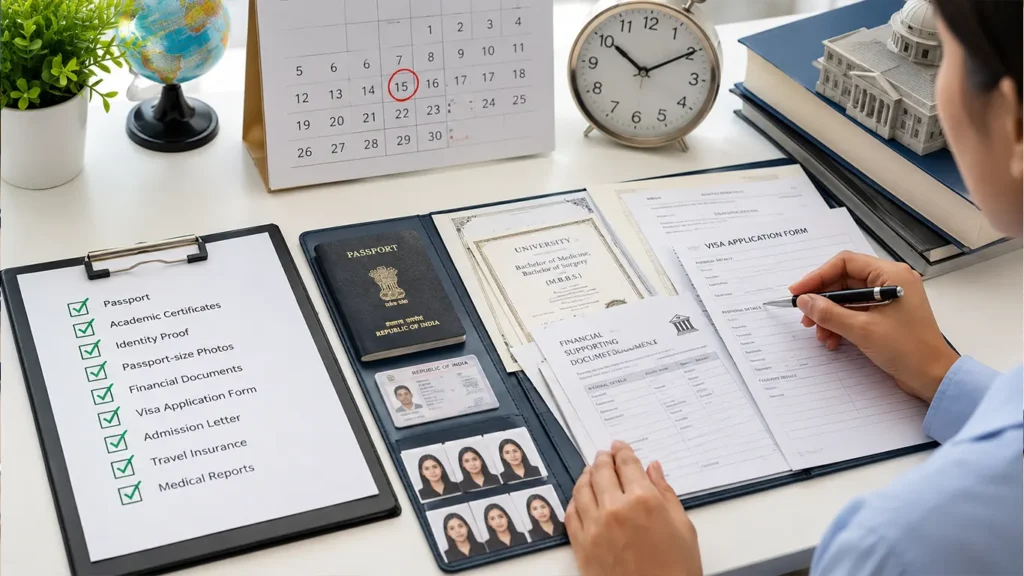
Double-check every document before submission to avoid visa delays